
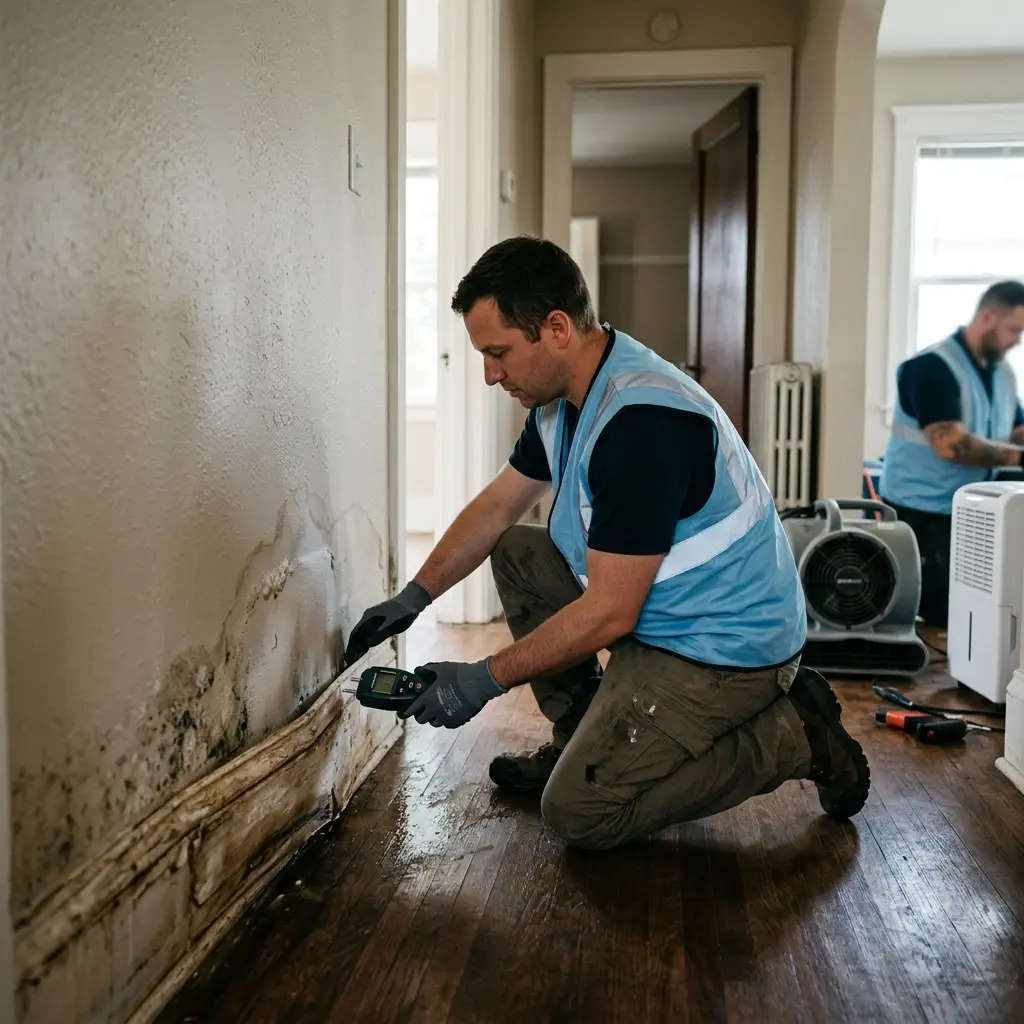
For a homeowner in Seattle, the sound of rain against the window is a familiar, almost rhythmic backdrop to daily life. We live in a region defined by its moisture. However, when that moisture migrates from the outside of your home to the inside of your walls, the consequences are anything but soothing. You might be walking through your hallway, or perhaps vacuuming the living room, when you notice something slightly off: the baseboards look a bit “puffy.” Maybe they are pulling away from the wall, or the paint looks like it’s beginning to bubble.
It is easy to dismiss this as minor cosmetic wear or “settling.” But in the world of water damage restoration, swollen baseboards are rarely just a cosmetic issue. They are often the first visible symptom of a much deeper, hidden problem that could be compromising your home’s structural integrity and your family’s health.
At American Water Damage Restoration, we have seen how a small “bump” in a baseboard can lead to thousands of dollars in repairs if left unaddressed. Understanding why this happens and what it means for your property is the first step in protecting your investment.
To understand why your baseboards are reacting this way, you have to look at what they are made of. Most modern Seattle homes use one of two materials for trim: solid wood or Medium Density Fiberboard (MDF).
MDF baseboards are essentially compressed wood fibers held together with wax and resin. While affordable and easy to install, MDF acts like a high-density sponge. When even a small amount of water touches the bottom or the back of an MDF board, the fibers absorb the liquid and expand rapidly. Once MDF swells, it rarely, if ever, returns to its original shape.
Solid wood baseboards are more resilient but are still porous. Over time, consistent exposure to moisture causes the wood cells to saturate, leading to warping, cupping, and “crowning.”
When you see swelling, it means the material has reached its saturation point. The water is no longer just “near” the baseboard; it has been absorbed into the core. This is a critical indicator that moisture is trapped at the wall-floor junction, the very place where water naturally collects and stays hidden.

The most alarming aspect of a swollen baseboard isn’t the board itself, it’s what is happening behind it. Baseboards are the “cap” on the gap between your flooring and your drywall. When water intrudes, it often travels behind the baseboard and begins to wick up the drywall and soak into the wall studs.
Because this area is dark, cramped, and lacks airflow, it creates the perfect “micro-climate” for disaster. Here is why you cannot afford to wait:
If you are noticing these signs, seeking professional water damage restoration is the only way to ensure the moisture is fully extracted from the hidden cavities of your home.
In our years of providing water damage restoration in the Pacific Northwest, we’ve identified several recurring culprits behind swollen baseboards. Identifying the source is the first priority in any restoration project.
Unlike a burst pipe that floods a room instantly, a pinhole leak in a supply line behind a wall can drip slowly for months. This slow wicking keeps the baseboard constantly damp, causing it to swell gradually. These are often the most dangerous leaks because they go unnoticed until the damage is extensive.
Is the swelling near your kitchen or laundry room? Dishwashers, refrigerators with ice makers, and washing machines are frequent sources of “silent” leaks. A slow leak from a dishwasher hose can send water under the kitchen cabinets and into the baseboards of the adjacent room.
Seattle’s heavy rains can saturate the soil around your foundation. If your home’s drainage system or sump pump isn’t functioning correctly, water can be pushed through the foundation via hydrostatic pressure. This often manifests as dampness and swelling along the baseboards in basements or lower levels. You can learn more about how we handle these situations on our water damage emergency page.
In some cases, especially in older Seattle homes with poor insulation, the temperature difference between the cold exterior and the warm interior causes condensation to form inside the wall cavities. This moisture eventually trickles down to the baseboard level.

When you call a professional for water damage restoration, one of the first things we do is categorize the water. This isn’t just industry jargon; it dictates the safety protocols and whether or not your baseboards can be saved.
For more detailed information on our specialized cleanup processes, visit our 24/7 water removal services section.
If you find a swollen baseboard today, do not panic, but do take action. Follow these steps to mitigate the damage:

You might think that putting a space heater or a box fan in front of the baseboard will solve the problem. Unfortunately, surface drying is often a recipe for disaster. While the outside of the baseboard might feel dry to the touch, the inside of the wall cavity remains damp.
When you hire American Water Damage Restoration, we use a scientific approach to drying:
Our goal is not just to fix the visible damage, but to ensure your home’s structural integrity is protected for years to come.
Imagine waking up to a small, barely noticeable warp in the baseboard behind your refrigerator. You decide to wait until the weekend to look at it. By Saturday, the warp has spread three feet down the wall. When our team arrives, we discover that a slow leak in the fridge’s water line had been saturating the subfloor for weeks.
Because the homeowner called us quickly, we were able to save the hardwood floors through specialized drying mats, though the MDF baseboards had to be replaced. Had they waited another week, the mold growth would have required a much more invasive mold removal and remediation process, potentially involving the removal of the kitchen cabinetry.

At American Water Damage Restoration, we understand that your home is your sanctuary. Seeing signs of damage can be incredibly stressful. That is why we position ourselves as your partner throughout the entire process, from the initial emergency call to the final reconstruction services.
We are a local Seattle company that understands the unique challenges of our climate. We are available 24/7 because water damage doesn’t wait for business hours, and neither should you.
No. Painting over a swollen baseboard only hides the symptom while the underlying moisture continues to cause rot and mold growth behind the wall. The material must be dried or replaced, and the source of the water must be fixed.
In most cases, yes: provided the damage was caused by a sudden and accidental discharge (like a burst pipe). Gradual leaks caused by a lack of maintenance are sometimes excluded, which is why a professional inspection and documentation are vital to your claim.
Typically, professional structural drying takes between 3 to 5 days, depending on the materials involved and the extent of the saturation.
Not necessarily, but it means the conditions for mold are present. If the moisture has been there for more than 48 hours, the risk of mold is significantly higher.
If you live in an area prone to moisture (like a basement or bathroom), switching to solid wood or even PVC trim can offer better long-term resistance to swelling, though no material is 100% waterproof.
If you suspect your home is suffering from water damage, don’t wait for the problem to grow. Contact us today or fill out our form submit for a professional assessment. We’re here to help you breathe easy again.