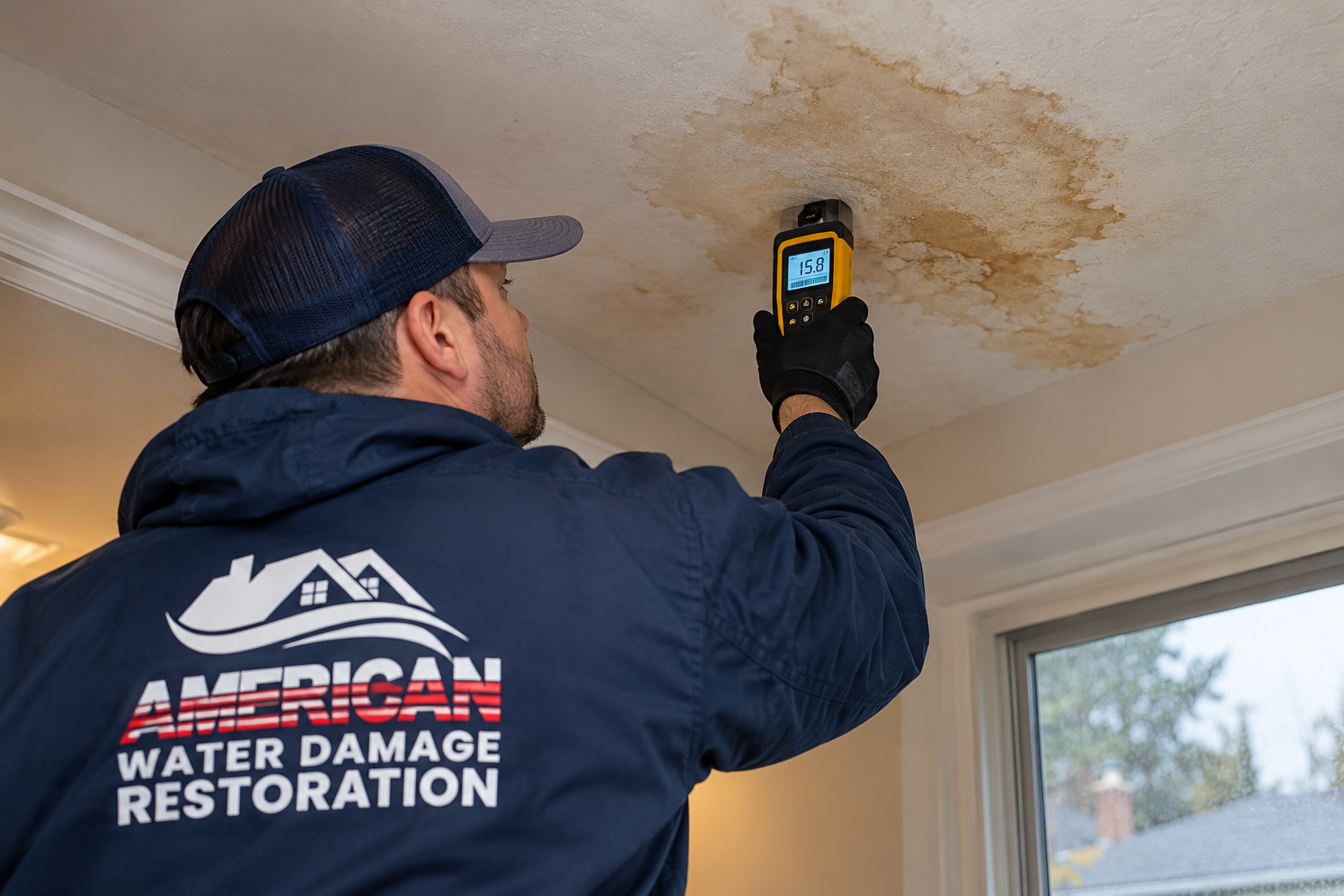
A brown stain on a ceiling may look like a cosmetic problem, but it can also be the first visible clue that water has reached materials above or behind the finished surface.
Where could the water be coming from?
A ceiling stain does not automatically mean the roof is leaking.
Possible sources include damaged roofing, flashing around roof penetrations, plumbing above the ceiling, condensation, or water entering around exterior openings.
The location of the stain—and whether it changes during rainfall—can provide useful clues.
However, determining the actual source may require inspection by the appropriate roofing, plumbing, or building professional.
Correcting the source comes before repairing the appearance.
Why a small stain can deserve attention
Water can travel along framing, piping, insulation, and other building components before finally becoming visible on a finished ceiling.
Depending on the construction, moisture may affect ceiling drywall, insulation, wood framing, adjacent walls, and building materials surrounding the original source.
A small stain does not necessarily mean extensive damage has occurred.
Likewise, a ceiling that feels dry at the surface does not establish that concealed materials are dry.
Professional moisture detection can help evaluate building materials when hidden water intrusion is suspected.
The objective is not to assume that demolition is necessary. It is to understand what actually became wet.
What should you do first?
If water is actively dripping, keep people and belongings away from the affected area.
Do not touch wet light fixtures, switches, outlets, or electrical equipment.
If the ceiling is sagging, bulging, or appears unstable, stay clear of the area and avoid puncturing or disturbing it.
Contact the appropriate roofing, plumbing, or other qualified professional to identify and correct the source of the water.
If building materials have become wet, water damage mitigation may also be appropriate.
Why painting over the stain is not the solution
Paint can conceal discoloration. It cannot stop water intrusion or dry concealed building materials.
The U.S. Environmental Protection Agency recommends addressing moisture problems promptly and drying water-damaged materials as quickly as practical, generally aiming for approximately 24–48 hours when feasible.
That timeframe is preventive guidance—not a guarantee that mold will or will not develop at a specific hour.
Depending on the extent and source of the water intrusion, restoration may involve moisture measurements, water extraction, structural drying, drying monitoring, and selective removal of materials when appropriate.
Not every water-stained ceiling requires demolition.
The correct response depends on the source, material condition, contamination concerns, and actual moisture conditions.
Look beyond the visible stain
If a ceiling stain appears after rainfall or a plumbing problem, consider what is located above and beside the affected area.
Water may have reached insulation or framing before becoming visible from the room below.
In a multistory home, the apparent source may also be a bathroom, laundry area, appliance, or plumbing line on the floor above.
A moisture assessment can help establish whether the problem is limited to the visible location or extends farther into surrounding materials.
Fix the source before completing cosmetic repairs
A useful restoration sequence is straightforward:
- Identify the water source.
- Correct the source.
- Determine which materials became wet.
- Remove unwanted water when necessary.
- Dry and monitor affected materials that can appropriately remain.
- Remove materials when conditions require it.
- Complete final repairs only after the moisture problem has been addressed.
Water damage assistance in Greater Seattle
American Water Damage Restoration LLC assists homeowners and property managers throughout Shoreline, Lake Forest Park, Kenmore, Edmonds, Lynnwood, Snohomish County, and the Greater Seattle area.
AWDR services include emergency water mitigation, water extraction, moisture detection, structural drying, sewage cleanup, mold remediation, and related restoration work.
If you have discovered an active ceiling leak or water-damaged building materials and are unsure how far the moisture traveled, contact American Water Damage Restoration at (206) 771-7040 or visit https://americanwaterrestorations.com.